Saturday, 29 June 2024

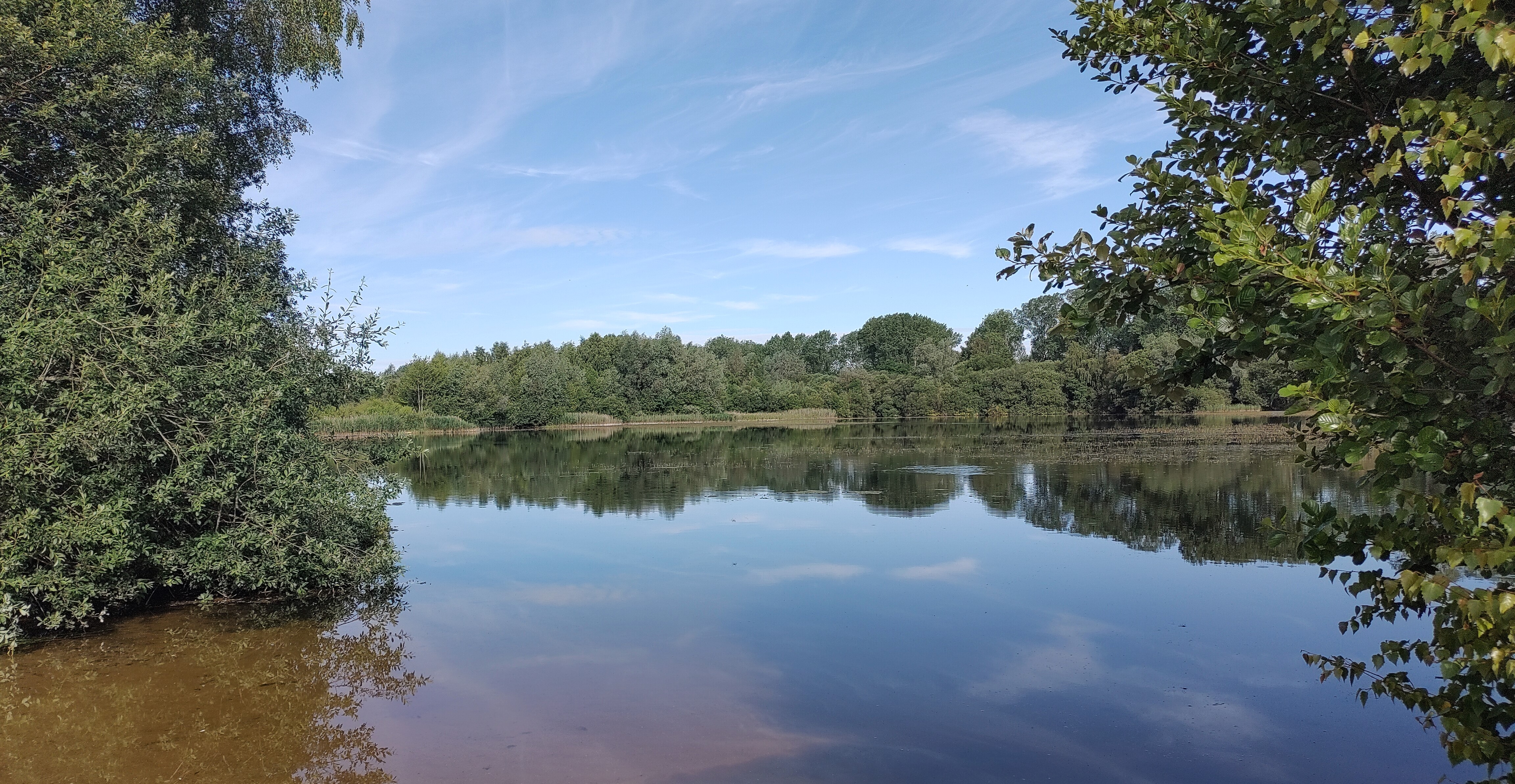
Lynford Water 29 June 2024

The early morning drive from my home in Watton to Lynford Water and Arboretum takes in stunning Breckland habitat, much of which lies within the large army training area known as STANTA (Stanford Training Area), in fact the drive to Lynford follows the northern and western limits of STANTA.

The morning began with cloudless skies and very warm sunshine, the day became increasingly warmer, however, high cloud moved in later in the morning.

I arrived at the Lynford Water car park at 0710, several visitors were already here to enjoy some early morning swimming in the larger lake.

Upon my arrival, I recorded Blackcap, Song Thrush, and Coal Tit singing in the wooded surrounds, also here was a singing Stock Dove.  Walking the track towards the lakes I heard Wren singing along with calling Nuthatch and Treecreeper.  I detected movement in the top of a tall Sycamore, I soon located a lovely female Blackcap searching for small invertebrates under the leaves, she was readily identified by her brown cap.  

1. Woodland trail near Lynford Water

The woodland trail from the car park eventually leads to open country between the woodland and Lynford Water, here, this open country was dominated by the beautiful blues of Viper's Bugloss, a stunning looking plant.  This open area also had patches of Broom and Gorse along with areas of young woodland scrub and the edges of the lakes mostly comprised dense willow habitat.
At least 4 Linnets were seen on Broom and Gorse scrub, one bird, a stunning male had a crimson forecrown and especially bright crimson breast patches, a very handsome bird.

2. Open area at Lynford Water with beautiful Viper's Bugloss

3. Open country with scrub habitat which held at least 4 Linnets
 
4. Young Conifer and Birch habitat holding Willow Warblers

The woodland edge adjacent to the clearing held a mobile party of Long-tailed Tits which included juvenile birds, these birds passed through woodland but also visited patches of scrub in the clearing in their search for food.  Blackcaps appeared to be the most common Warbler heard with several males singing, most were in mature patches of woodland whereas a couple of Willow Warblers were present in typical habitat of young conifer and birch (picture 4) with ground cover for nesting.  Once these conifers have become well established the ground beneath will become devoid of light and ground cover, thus rendering this habitat being unsuitable for ground nesting Warblers.
A calling Great Spotted Woodpecker and singing Blackbird were present here.

5. Blackcap (male) The most numerous Warbler present at Lynford Water

A beautiful area of Hawthorn and Birch scrub hosted singing Blackcap and Whitethroat, also present here was 2 singing Garden Warblers and Chiffchaff.  Nearby in Willow scrub by the lake, two male Reed Buntings sang. A check of the lakes saw two pairs of Great Crested Grebes, both pairs having two juveniles each.  A mixed habitat of young Birch and Hawthorn held my third singing Garden Warbler of the morning.  A single Hobby passed by high overhead whilst nearby a pair of Buzzards were soaring. 

Lynford Water held two pairs of Great Crested Grebes (each pair had two juveniles)

The final part of my visit was a gentle stroll around the car parks where 2 male Goldcrests were singing in mature conifer habitats.  A single Siskin passed over calling.

Mature woodland held beautiful Scots Pines

My delightful visit to Lynford Water ended when I met up with my friend Thomas Adcock who stopped for a good chat and very kindly bought me a coffee.  Thank you Thomas, it was good to see you and 'Patch'.


Lynford Water Birds
Mallard, Great Crested Grebe (2 pairs + 4 young), 1 Cormorant, 2 Buzzard, Moorhen, Stock Dove (2 singing males), Wood Pigeon, 1 Great Spotted Woodpecker, 1 Hobby, Magpie, Jackdaw, Carrion Crow, 3+ Coal Tits, Blue Tit, 1 Skylark, Swallow, Long-tailed Tit, 2 Willow Warblers (singing males), 6+ Chiffchaff, 10+ Blackcap, 3 Garden Warblers (singing males), 1 Whitethroat, 3 Goldcrests (singing males), Wren, 1 Nuthatch, Treecreeper, Blackbird, 4+ Song Thrush, Robin, Dunnock, Chaffinch, 4+ Linnets, Siskin, 2 Reed Buntings (singing males)


Friday, 28 June 2024

28 June 2024

A much more comfortable day today following yesterdays humidity.  Looking ahead, the coming weekend looks reasonable, quite warm, but with more unsettled conditions next week and below average temperatures.  

I had a lengthy appointment at the Norfolk and Norwich Hospital today, therefore I gathered a few widely scattered records beginning with some casual observations in and from the garden.

Early morning in the garden saw a juvenile Robin on the lawn, also a juvenile Blackbird fed upon provided apples.  Overhead a single male Greenfinch performed its song-flight and a single Lesser Black-backed Gull passed by.  House Sparrows in the hedge gave an alarm call, this alerted me to the presence of a raptor, seconds later a single Hobby passed through at speed, as it turned the early sun caught its beautiful all-grey upperparts.  About an hour later, another, or possibly the same Hobby flew at speed and in a shallow dive, clearly a hunting bird.

At the hospital the car park held Pied Wagtail and a singing Blackcap.

I decided upon taking a back roads drive back home to Watton which took in the beautiful countryside at Wicklewood and Deopham.
As I approached Wicklewood a Red Kite flew up from road kill upon which it had been feeding from.  Later, whilst driving over the former Deopham airfield, a few House Martins flew low over crops in their search for food, also, a single Kestrel was hunting and a single Pied Wagtail was on a muck heap, a good food source.

Back at home a single Red Kite drifted slowly over the estate and a soaring Buzzard was present.  Perhaps the epitome of an English summers day is seeing and listening to screaming parties of Swifts, such a display occurred overhead.  Wonderful !  

Friday, 21 June 2024

Hingham(Seamere Marsh) 21 June 2024 (1100-1145)

 I had a late morning break so decided to have a quick survey of birds at Seamere Marsh.  A pleasant day with something more akin to summer with long sunny spells and warming temperatures.  

Over the years this location has provided some surprises with my most exciting find being in February 2019 when I found a Corn Bunting in a broken hedgerow by a field of weed seeds.  This bird was certainly a rare bird in this part of Norfolk.

With only limited places to overview this wonderful location and habitat, most records of singing birds are gathered from within earshot, clearly, the habitat here lends itself to good numbers of breeding birds, especially Warblers with most notable genus being Acrocephalus and Locustella species. A broken hedgerow comprising a few scattered trees and close to marshland habitat produced most records today.

3 Buzzard
1 Kestrel
2 Stock Dove (Pair displaying and song heard)
2 Blue Tit
1 Chiffchaff (singing male)
Blackcap (singing male)
Whitethroat (singing male)
1 Lesser Whitethroat (singing male)
1 Reed Warbler (singing male) undoubtedly more present.
2 Dunnock
Blackbird (singing male)
2 Wren
1 Yellowhammer
2 Reed Buntings (singing males)

Overviewing Seamere Marsh 21 June 2024

An interesting short visit to this beautiful location with several species seen or heard in the broken hedgerow in the middle of the above picture.  On the distant marsh a couple of male Reed Buntings held territory with one bird remaining for the whole of my visit on the only patch of willow scrub visible (a typical nesting site).  
The broken hedgerow habitat held singing Whitethroat, Lesser Whitethroat, and a single Reed Warbler which sang only very briefly.  The habitat here clearly will hold more Reed Warblers. Resident species present included singing Wren (3), singing Blackbird, singing Dunnock, and a lovely scoped view of a male Yellowhammer singing on the top of an old Hawthorn. 
The highly visible display flight by a pair of Stock Doves was seen over the marsh, both alighted in a large nearby Oak where the monotonous song was heard.


Wednesday, 19 June 2024

Garden Observations 19 June 2024

Today I had several jobs to do in the garden, therefore, the following is a list of bird species either seen in the garden, or seen from the garden.

Sparrowhawk seen passing over garden
House Sparrow (adults/juveniles)
Starling (ad/juvs)
4+ Blackbird
30+ Swift
Blue Tit (ad/juvs)
6+ Herring Gulls
Rook
Jackdaw
Wood Pigeon (on nest)
Collared Dove
Magpie
1 Lesser Black-backed Gull - North
4+ Buzzard
1 Sparrowhawk (female)
12+ Goldfinch
1 Greenfinch (singing male)
2 Dunnock

My forty feet long hedgerow in my garden was planted by myself 10 years ago and comprises all native species, these being Hawthorn, Blackthorn, Dogwood, Dog Rose, Silver Birch, 1 Ash tree, Goat Willow, and a couple of Alders.  This habitat is attractive to nesting species, birds seeking food and shelter, and also acts as a corridor for birds and insects to pass through.

The most visible birds present today was House Sparrows and Starlings, both species accompanied by young birds.  Goldfinches were particularly mobile with single figure birds (largest number of 7 birds) passing through.  Young Goldfinches were present, these are identifiable by their plain brown heads. A single male Greenfinch was singing.

Both adult and juvenile Blue Tits passed through, one juvenile seen quite well feeding in the willow.  The juvenile Blue Tits are readily identified by their distinctive yellow cheeks (white in adults).  A Wood Pigeon was on the nest in the willow.

Overhead movements in the morning saw at least 6 Herring Gulls pass over and one Lesser Black-backed Gull flew North.

By mid-afternoon it was sunny and pleasantly warm.  A female Sparrowhawk passed low and directly over the garden, this bird was clearly carrying prey in its talons.  

Swifts were present all day with a notable gathering high overhead in the evening.   


Sunday, 16 June 2024

5 June 2024 (Sylvia Warblers)

A productive visit to an area of Little Cressingham which in previous years has always been reliable for Sylvia Warblers.  The habitat here comprises hedgerow, scattered hedgerow trees, bushes, scrub, and a predominantly Larch belt.

As predicted, the four Sylvia species I expected to see were indeed present, these were Whitethroat (singing male), one Lesser Whitethroat (singing male), 2 Blackcaps (singing males), and one Garden Warbler (singing male).
The most vocal of all four Warbler species on this visit was a singing male Lesser Whitethroat, this bird flew the whole length of the hedgerow in this picture and continued to sing with brief glimpses of this bird either in flight or moving in cover.

Garden Warbler

Little Cressingham 5 June (Lesser Whitethroat and Garden Warbler present here)


Little Cressingham 5 June.  Typical Sylvia Warbler habitat. 

Lesser Whitethroat - an absolutely stunning Sylvia.

Dog Rose at Little Cressingham 5 June

Also seen on this visit was a male Woodlark, this bird was singing overhead, it also was seen dropping to a nearby field on a couple of occasions to feed and collect food which was carried into the nearby training area.
A distant male Sparrowhawk was seen flying low and fast over a large field before entering nearby woodland.  A memorable observation was seeing the Sparrowhawk turn to reveal its distinctive blue-grey upperparts.
Finally, a single Cormorant was seen very high overhead circling, and then watched flying off in a westerly heading whilst remaining very high.

Friday, 14 June 2024

May 2024

May 2024 will be remembered for being one of the wettest May's on record.  Locally, on the patch, many low lying areas were under significant amounts of water and both rivers and ditches ran much higher than normal. 

4 May
First thing in the morning I heard the great pleasure of walking a friends beautiful dog around Merton Common, on this walk I counted 5 Whitethroat territories, all of which were singing ♂♂.

Later in the day I visited a flooded meadow at Bodney where 5 Little Egrets were present. One Little Egret was watched wading in shallow water and using a foot to stir up the mud in its search for invertebrates.
A single Kingfisher was briefly seen flying at speed along Watton Brook.
On the way back to Watton a single Little Egret was seen flying west over the town.  Later in the afternoon a calling Cuckoo was heard in the Merton area.


8 May
Birding today was confined to the garden due to the effects of Covid

My first Hobby of the year was seen directly above the garden where it soared for a short while. Other raptor species seen included a female Sparrowhawk which passed through the garden low and at speed. 3+ Buzzards were seen from the garden and in the garden both Wood Pigeon and Collared Dove had nests in our hedgerow.

10 May
A very productive day on the patch with evidence of passage waders at Bodney and of breeding behaviour and successes in the Bodney and Little Cressingham areas.

Little Cressingham/Bodney (Hopton Bridge W to flooded meadow at Bodney)
A fantastic start to this visit with a pair of Whitethroats, 3 Grey Wagtails, a stunning ♂ Blackcap, singing Mistle Thrush and Chaffinch, and a ♂ Great Tit in the tall Poplars, all within minutes of my arrival.
Whitethroat (one of a pair) Little Cressingham 10 May

With low lying areas remaining under significant amounts of water, I decided to visit a flooded meadow at Bodney where I located 3 Redshanks, all three birds were wading in shallow water and probing to feed.  A nicely proportioned bird, these Redshanks are medium-sized waders with a medium length straight bill which is red at the base with the distal half being black.  A brown bird with a bright white eye ring and dark lores.  The underparts are white with neat arrowhead like markings.  The legs are red.  In flight the trailing inner wing (secondaries) have a broad white bar.

Other wader species present included singing Snipe, a pair of Curlew, Lapwing (including a young chick), and a single Oystercatcher.
Wildfowl present included Mute Swan, a pair of Shoveler, Gadwall, and a pair of Mallard with ducklings.

Little Egret at Bodney 10 May

A single Little Egret overflew the flooded meadow.  The picture here shows a beautiful pure white bird with a black dagger-like bill and black legs with yellow feet.  In the ditch below the Egret a single Reed Bunting held territory in suitable breeding habitat.

Grey Wagtail at Little Cressingham 10 May

In the Watton Brook valley at Little Cressingham at least 3 Grey Wagtails (2 juveniles) were present. I am sure you will agree how striking the Grey Wagtail is.

14 May
An early morning visit to Little Cressingham saw a female Goshawk soaring above woodland for a few minutes before descending rapidly into trees.  Goshawks are encountered on frequent visits to the patch, these species is the definition of power.
Also noted on this visit was 3 Little Egrets which flew east until lost to view, and along a tree-lined track a Lesser Whitethroat was singing.

22 May
The morning was very wet with persistent heavy rain, this cleared to an afternoon of frequent heavy showers and with highly variable light, thick black cloud was driven along in the wind and short spells of bright sunlight produced the variable light.

Little Cressingham 22 May. An afternoon of highly contrasting lights. 

Despite the at times poor conditions (and getting very wet) I was treated to the fantastic display-flight of a Snipe.  This bird chose to display under very dark cloud and rain and when a shaft of light caught it, well, it was stunning.  This Snipe performed circular flights directly above me and in shallow dives I could clearly hear the vibrating winnowing sound, this sound is produced by the outer tail feathers being held at an angle from the rest of the tail, the passing air causes the beautiful vibrating sound.  Once the circular display was completed the Snipe dropped rapidly to the ground, it was then I briefly heard the "chipper chipper" song.  A very memorable sighting and sadly, becoming rarer. I remember a farmer once telling me that the vibrating sound is likened to the bleating of lambs.  In the 19th century, Ornithologists thought this vibrating sound was the bird calling. 

28 May
A very pleasant early morning visit to Bodney where I walked an area of vast arable habitat with commanding views over exposed open country.
The most obvious species both seen and heard was Skylark with many performing song-flight, an encouraging observation saw a couple of Skylarks carrying food for young which were hidden somewhere within a young wheat crop.
 
Skylark at Bodney carrying food for young 28 May

Also seen on this visit was a single Woodlark performing its song-flight high overhead.  This is such a sweet song which comprises beautiful prolonged notes as "lululululululu".  The Woodlark is a Breckland speciality and is a target species for visiting birders.  
A single male Cuckoo was calling distantly but then located visually as it moved through treetops with some urgency.
A small patch of Bramble scrub looked good for a Sylvia species, moments later, a male Whitethroat was singing.  Two male Blackcaps were singing as was a single Song Thrush.  A male Stock Dove sang its rather monotonous "Ooah Ooah Ooah Ooah" song.
 

Thursday, 13 June 2024

Cattle Egret at Bodney 21 April 2024

A single Cattle Egret seen with 2 Great White Egrets and 2 Little Egrets in the Watton Brook valley north of the Sewage Treatment Works. The Cattle Egret was later seen on the flooded meadow east of the STW. This record of Cattle Egret is my first on my local Breckland patch and although an exciting record, my feelings have been for some time that this species would be seen on my patch sometime in the near future.

Cattle Egret at Bodney 21 April 2024

With all three Egret species seen together, comparisons were easy to see.  The more familiar Great White and Little Egrets need no comparison notes, however, the Cattle Egret, being less familiar, showed obvious differences from the other two species.  The Cattle Egret was the smallest of all three species, it was also a stockier looking bird with a short, thick neck, a strong short bill, and a definite jowl.  A faint yellow-orange wash on the crown indicated this was a male bird.

The Cattle Egret was first seen in the company of two Great White Egrets and two Little Egrets on flooded meadow habitat.  The Cattle Egret fed by probing with occasional short chases for prey.  I noticed that the Cattle Egret often wandered into thick grass habitat in its search for food.