Saturday, 31 October 2015

Thompson Water, Norfolk

With my first tour date just 3 days away, I decided this morning to walk the route at Thompson Water that I intend to take my group along.  The woodlands in this area are quite extensive and it is my hope that my group will have the right light to appreciate the beautiful autumn colours in this area. 
An initial overview of Thompson Water produced my first of 2 calling Water Rails in reeds on the opposite side from where I was standing.  On the water quite a few Mallard were accompanied by lesser numbers of Gadwall.
Water Rail at Thompson Water (photographed Jan. 2015)
The walk along the western fringe of the water comprises a variety of habitats, if walking north, on your right is thick swampy carr, waterside scrub, and dense reedbeds, whilst on the left is mixed woodland, mostly deciduous, with Pingos with fluctuating water levels.  Many fine Oaks and wonderful Holly specimens are seen here.
Whilst walking along this path a Cetti's Warbler sang its explosive song, I was able to more or less pin-point where the bird was, I stood for some time with the bird singing around me, sometimes very close, however, such is the secretive life of this bird, could I see it, no I couldn't.  I couldn't even see any movement of reeds or twigs which would betray the birds presence...what a clever bird.
Thompson Water 31/10/15
Another enigmatic bird of dense reedbed habitat is the Water Rail.  My second bird of the day was in the same area as the aforementioned Cetti's Warbler, and was at times very close, I could hear some splashing but the bird did not show itself to me.
The photograph here shows the dense reed habitat along with Sallow scrub where both Cetti's Warbler and Water Rail were heard today.
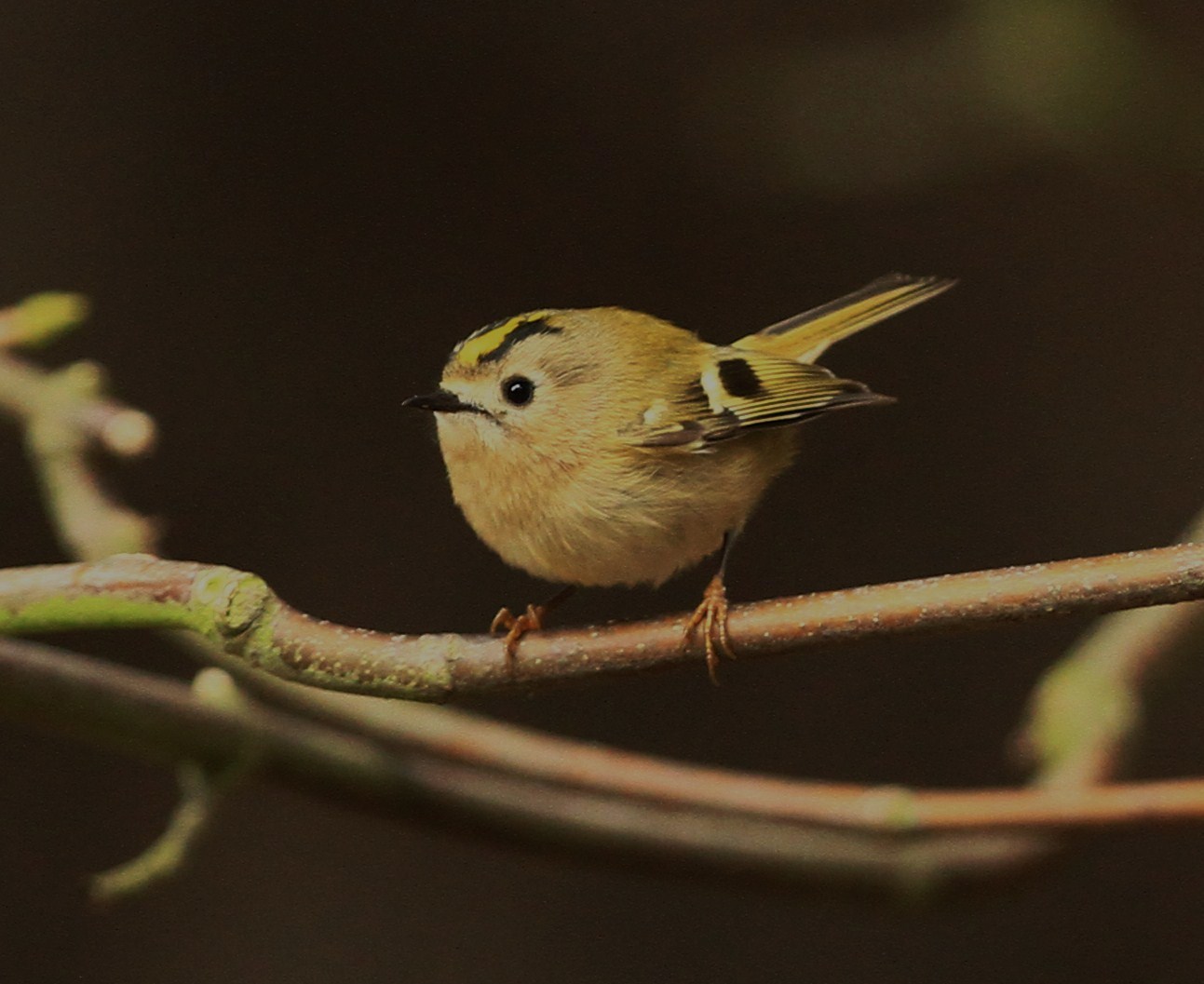
Also along the woodland/water periphery was mobile Tit flocks comprising Long-tailed Tits, Marsh Tit, Coal Tit, Great Tit, Blue Tit, Goldcrest, and Treecreeper.  Nuthatch was also seen.
Whilst in the woodland there was an explosion of Wood Pigeons flying from trees in a hurried and disorganised fashion, shortly after this Corvids gathered in the sky above the water, I suspected Goshawk, however, I was unable to see the cause of this behaviour.

Kimberley, Norfolk
A visit to a good friend in the grounds of Kimberley Hall brought an unexpected surprise.  Whilst in his garden, and in full sunlight, a large Bat species appeared above the woodland canopy.  I regret to say that my Bat identification skills are not as good as I would like.  The Bat would fly in a direct, leisurely flight but would suddenly make a dive for prey.  Flying away from me the Bat appeared to have an occasional 'clipped-like' wing-beat similar to a Turtle Dove, or somewhat similar to the clipped beats performed by a Common Sandpiper close to water.  Being large and over woodland within extensive parkland habitat, could this have been a Noctule Bat?

Monday, 26 October 2015

Surlingham Church Marsh, Rockland Broad, Strumpshaw Fen, Buckenham Marsh, and Halvergate Marsh, Norfolk (with Jim Bradley)

On the 3rd, 4th, and 5th November, I will be leading birding tours of both Breckland and Broadland.  In order to familiarise myself with Broadland reserves, my guide for today, and birding friend, Jim Bradley, took me on a pre-tour recce in order to show me routes and places to stop, and the birds we are likely to see and hear during my tours.  May I say at this stage of this account that Jim's guidance was extremely invaluable.  Jim's knowledge of the routes and the birds likely to be found in specific areas/habitats was second to none.  Thank you Jim.       

Surlingham Church Marsh
What a fantastic small Broadland reserve this is and a great location for those joining me on the tour here on 4th November.  A gentle stroll around this reserve doesn't take too long, however, the diverse bird-life here will hold any visitors attention.  The marsh lies immediately adjacent to the River Yare, consequently, following a high tide, the paths here came become very muddy...appropriate foot wear a must.
Jim initially took me along a path which descends into the marsh and the Riverside, the habitat here held calling Water Rails and singing Cetti's Warblers, whilst the path-side trees and bushes held Bullfinch, and winter Thrush species.  A flock of about 10 Redpoll was seen over the marsh.
A short stop in the hide which overlooks the marsh produced another calling Water Rail in thick reed-bed cover.  Teal, Mallard, and a Grey Heron seen on the lagoon, whilst on the river a Kingfisher was seen and calling.  Overhead, Jim pointed out a fine looking female Sparrowhawk circling briefly over the marsh.
Approaching the end of this visit to Surlingham, another Kingfisher sat silently in a a bush overhanging the water.
Just prior to leaving, Jim showed me the grave of that wonderful Norfolk Naturalist, Ted Ellis, and his wife at the beautiful ruin that is St Saviour's church.  Ted Ellis was a man I would have loved to have met, he was a gentle man, and gentleman.

Rockland Broad
Upon arrival  flock of about 10 Redwings dropped in, presumably to feed upon the wealth of Rowan berries there.
The walk along the path to Rockland Broad is quite long and relatively dry.  The path on one side is lined with Sallow and various tangled habitat, this habitat held singing Cetti's Warbler.  Eventually tha path leads to open extensive marshland on both sides of the River Yare, this area held a female juvenile Marsh Harrier. A small area of woodland held a mobile Tit flock which included Goldcrest.
A short visit to a hide overlooking Rockland Broad produced Great Crested Grebe, a large number of Greylag Geese on the water, also a single Tufted Duck was with them.  Distantly, a Kestrel was seen hunting, this was then mobbed by a second Kestrel.

Strumpshaw Fen
Jim and myself arrived at an already busy RSPB Strumpshaw Fen reserve car park.  This fabulous location is to be the second venue of my tour following Surlingham Church Marsh.
Grey Heron at Strumpshaw Fen 24/10/15
Our first stop was at the Reception hide,  a wonderful initial stop for overviewing a habitat of marsh and a lagoon, and giving a flavour of what could be an excellent visit to this special reserve.
On this visit, Grey Heron (pictured) was een fairly close to near reeds and nearby was a few Mallard.
We then walked on to Fen hide  from where we saw a very distant Great Grey Shrike sitting typically on the top of a bush.  This bird must have been at least a half-mile distant from the hide, however, the unmistakeable behaviour of sitting on a high vantage point was useful.  Even better still, the Shrike made a couple of flights from the bush climbing quite high to catch a passing insect or small bird which was then taken back to the perch.  During these flights, the highly distinctive blacks and whites of the bird, the behaviour seen, and the return to the same perch, all helped with its identification despite the distance involved here.
Having left the hide to head back to the car park, Jim spotted our first of two Weasels of the day.  Back at the visitor centre a feeder produced Marsh Tit, Great Tit, and Chaffinches.

Buckenham Marsh
Our nest visit was to the wonderful Buckenham Marsh.  This was my first visit to this location.  From the car park we walked the path to the River Yare with overviews of marsh on both sides of the path.  What was particularly memorable for me, and I remember commenting to Jim on this, is that the landscape and habitats seen here is exactly the same as Beccles Marshes where I spent many happy days back in the 1960's and 70's.
Walking along the path Jim pointed out a scrape to our right, here was very good numbers of Wigeon, some giving their beautiful "weeeoo" call.  Also here was Lapwings and a single Snipe, whilst on the marsh was Greylag Geese.  A massive Great Black-backed Gull gave good comparison against a nearby smaller Lesser Black-backed Gull, and an even much smaller Black-headed Gull.
Whilst walking towards the River Yare, Jim looked back to scan the distant areas of marsh and located a Peregrine sitting on the ground, it appeared to be sitting on a slightly raised mound.  Despite the distance, the Peregrine was highly distinctive as it sat motionless and upright, and revealing its Grey upperparts and white underparts.  Either the bird was resting following a feed, or it was waiting possibly for the Wigeon to be put up for the chase.
A small flock of Barnacle Geese sat together on the marsh whilst more Greylags were seen along with Mallards splashing about in the ditch nearby.
Chinese Water Deer at Buckenham Marsh 24/10/15
The walk back along the path saw our second Weasel of the day. This small mammal ran in and out of cover as it came towards us, and somehow sneaked past us came out out of the grass behind us.
As we neared the end of this visit I spotted a Chinese Water Deer close to us on the road.  This was my first sighting of this lovely Deer species.  Having read up on Chinese Water Deer I have come to learn just how vulnerable this species is on the world scale.  Norfolk holds 10% of the world population of Chinese Water Deer, clearly its escape from Woburn in the 1920's has given this endangered mammal a good chance of survival here in Norfolk.

Halvergate Marsh
This was our final stop of the day.  We had been lucky with the weather, however, rain set in whilst visiting Halvergate.
As soon as we got out of the car Jim straight away picked up some Redpolls (about 10), which had alighted on a fence close to us.  This was a good opportunity to see and appreciate the lovely red/black forecrown and black chins of these birds, especially given that these Finches are almost always in fight...a good find by Jim.
With light fading and rain setting in most birds seen were Crow species. 
Despite the rain, I love to experience the various moods of weather and to witness the changing lights and overall feel of the places I visit.  It may feel too bleak for some, but both Jim and myself commented that we love bleak.

Birds seen/heard 24/10/15
Mute Swan, Pink-footed Goose, Greylag Goose, Canada Goose, Barnacle Goose, Shelduck (1), Egyptian Goose, Mallard, Gadwall, Wigeon, Teal, Tufted Duck (1), Pheasant, Great Crested Grebe, Cormorant, Little Egret, Grey Heron, Marsh Harrier, Buzzard, Sparrowhawk, Kestrel, 1 Peregrine (Buckenham Marsh), Water Rail, Moorhen, Coot, Lapwing, Snipe, Black-headed Gull, Lesser Black-backed Gull, Great Black-backed Gull, Wood Pigeon, Collared Dove, Kingfisher, Great Spotted Woodpecker, Skylark, Meadow Pipit, Pied Wagtail, Dunnock, Wren, Robin, Song Thrush, Redwing, Fieldfare, Mistle Thrush, Blackbird, Cetti's Warbler, Goldcrest, Great Tit, Blue Tit, Coal Tit, Marsh Tit, Long-tailed Tit, Bearded Tit, Treecreeper, Great Grey Shrike (Strumpshaw Fen), Magpie, Jay, Jackdaw, Rook, Carrion Crow, Starling, House Sparrow, Chaffinch, Redpoll, Goldfinch, Greenfinch, Bullfinch, Reed Bunting.

My Thanks
I will end this account by thanking my birding friend Jim Bradley for being my expert guide to his patch.  Primarily, the reason for this day out with Jim was for me to get the feel of the various sites we visited today in readiness for the tours I will be conducting in early November.  I was not too familiar with these reserves prior to our visit, however, I finished the day in the knowledge that I now know my routes to take, places of interest to stop at, and which birds occur where, and all of these factors are all down to Jim's superb guidance.  Than you Jim.

Friday, 23 October 2015

Hockham Fen, Norfolk

This morning we had first real frost of autumn, it was a light frost with the car windscreen slightly iced. 
I arrived at Hockham Forest long before sunrise and with the woodland in almost complete darkness.
Hockham Fen 23/10/15
The walk along the forest rides, despite being in darkness produced calling Redwings and Song Thrushes and Goldcrests were stirring.  A male Tawny Owl was calling.
Bu the time I got to Hockham Fen it was starting to get light so I sat down overlooking Reedbeds, weedy ditches, grassland, Sallow/Alder Carr and mixed woodland habitats.
2 Red Deer crossed the fen at dawn and despite being quite concealed these beautiful animals knew that something was not right, they frequently stopped and nervously looked my way before continuing through the reeds,
Siskins were one of the first species to be heard and seen overhead, these were followed by singleton Fieldfare and Redwings passing over.  One Buzzard flew over the fen.
2 Mute Swans arrived from the west at separate times and Teal were "kleeping" within the swampy fen.  Later in the winter months, very large numbers of Teal will occur on the fen.
The only other raptor seen today was a hunting Kestrel. Bramblings, mostly small numbers, passed over the fen and a single calling Redpoll passed overhead.
My walk back along the forest rides produced typical mixed woodland species including Long-tailed Tits, Goldcrests, Treecreepers, Nuthatch, and Tit species.
As I was nearing the end of my walk a good count of 8 Bullfinches passed through the canopy of pine woodland.

Thursday, 22 October 2015

Great Cressingham, Norfolk

Peddars Way LDP (North of Watton Road) and Watton Road
At the time of writing there are several Great Grey Shrikes in Norfolk and given the wide open vast rolling countryside in this part of Breckland then surely I must have a Shrike present somewhere.  This afternoon I walked habitat which could easily support Great Grey Shrike, and indeed, this will my focus in the coming weeks on the patch, to search for this stunning bird.
This afternoon I walked some roadside hedgerows which edge the fields and located a couple of Goldcrests and Robins.  Overhead, a small number of Golden Plover were seen, a count later when the birds were settled on a very large field of winter wheat produced at least 120 birds.
Looking distant west towards the village of Great Cressingham I could see a single Red Kite quite low and lots of Corvids.  A large field of stubble produced at least 40 Skylarks whilst beyond the field where the land descends towards Watton Brook, a large flock of Corvids were put up.
Walking back north along the Peddars Way towards the car, a single pale looking Buzzard was standing proud and alert on a dead branch with a wooded hedgerow.  A single Meadow Pipit passed over as did a small flock of 6 Redwings.

Wednesday, 21 October 2015

Starling Spectacular

On Tuesday 20th October I joined my very good friend Richard Farrow for a days birding on the North Norfolk Coast at Burnham Overy Dunes.  I arrived to meet Richard at our start point on the A149 coast road.
Arguably, October is the best month of the year for birding if your specialist passion is migration, and we were straight away reminded of this natural phenomena when many hundreds of Pink-footed Geese appeared over the Dunes and marsh to make their way inland to feed for the day.
It was clearly evident that a fall of Robins and Goldcrests had occurred, and this became even more apparent as the day wore on, especially with Goldcrests, which numbered in their hundreds.

From first light flocks of Starlings appeared in the east and passed over in a westerly heading, this passage became more frequent and heavier as the morning went on.  Varying sizes of flocks were seen with the largest numbering many hundreds and once one flock passed over, another soon appeared, and so this continued all morning with numbers and flocks petering out by the afternoon.
During their passage the largest flocks of Starlings moved on in very wide waves with several hundred meters from one end of the flock to the other.  It is fair to conclude that the numbers of Starlings involved in this passage numbered many thousands of birds.
These flocks of Starlings were often accompanied by other species, mostly Finches, most appeared to be a mixture of Chaffinches and Bramblings, but also Greenfinches and smaller numbers of Siskins and Redpolls, however, late morning one flock of Starlings comprised Finches which included at least 4 Crossbills whose distinctive flight call was clearly heard.

Origins
Literature indicates that Starlings move at varying times according to where they depart from.  Mid October in undoubtedly the peak for migration with the birds seen today originating from Finland, Russia, Poland, and the low countries.  The aim of these Starlings is to abandon the much colder winters in Northern Europe ad to seek warmth and feeding in Britain where they will join British birds and form very large flocks.  The vast murmurations and the spectacular pre-roost displays for which Starlings are famous for will undoubtedly be a mixture of both British and Continental birds.
Return migration to Northern Europe by continental Starlings starts in March of each year.
This particular visit to the North Norfolk Coast saw many migratory species to keep one entertained, but just as exciting was watching this wonderful spectacle of Starling migration.

Tuesday, 20 October 2015

Burnham Overy Dunes, North Norfolk (with Richard Farrow)

At 0700 I met my very good friend Richard Farrow on the small car park just off the A 149 coast Road west of the Holkham Estate on the North Norfolk Coast. Following an early coffee and chat, Richard and myself then walked north along the path which leads to Burnham Overy Dunes.  We were initially greeted by many hundreds of Pink-footed Geese making their way inland to feed.
As light improved it was clear that lots of Robins were present in the hedgerows, an indication of overnight arrivals.  Further along the path, a relation of Robin, a male Stonechat, was seen in a Hawthorn.   A singing Cetti's Warbler gave its explosive song.
From first light, Starlings were on a westerly passage, some flocks numbering several hundred, however, by the end of the day, several thousand Starlings were involved in this spectacular passage.
Burnham Overy Dunes, North Norfolk, 20/10/15
At sunrise, Richard and myself reached the end of the path where it meets the beginning of the massive dunes system.  At this point, the first area of patchy scrub was to prove very interesting.  Initially, Linnets and Reed Buntings were present in the Bramble/Hawthorn scrub along with recently arrived Redwings and Song Thrushes.  Things got even better when a good number of 30+ Goldcrests arrived and immediately started to forage in the scrub as well as weedy growth between the path and the tidal creek.  This was the start of what was to be an excellent day for Goldcrests with birds being seen in very good numbers wherever habitat occured within the dunes.

Goldcrest in Sycamore at Holkham 20/10/15 (Possibly a migrant from Russia)
A check of the nearby creek produced Redshanks and a single feeding Grey Plover.  A small gathering of Godwits were seen as well as a few Dunlin.
Following this productive start in the dunes we then walked east, heading towards the Pines at Holkham Wood.  Productivity continued with further Goldcrests being encountered wherever scrub habitat occured, whilst overhead, continuing waves of Starlings continued their westerly passage.  These Starlings were often accompanied by Bramblings, Chaffinches, Greenfinches, Siskins, Redpoll, and on one occasion 4 Crossbills, all of which were heading west.
An overview of Holkham Marshes produced a single Great White Egret flying east, this stately bird was later relocated within the marsh, and appearing very Heron like compared to the more hunched up Little Egret, of which several were seen.  Also on the marsh was Buzzard, Marsh Harrier, Sparrowhawk and at least 3 Kestrels.
A check of a deep scrub-filled depression in the dunes produced a number of Redwings, Song Thrushes, and Robins.  Goldcrests continued to dominate, also a smart looking female Blackcap was seen in thick scrub on the side of the depression.

Redwing at Burnham Overy Dunes 20/10/15
As we entered Holkham Pines we first checked an area of Sycamores, here once again, Goldcrests were very numerous. Our aim was then to walk the full length of Holkham Pines to as far as Lady Anne's Drive.  On route, Goldcrests presented as being very abundant, but also a couple of Chiffchaffs, Coal Tits, and Long-tailed Tits were seen.
Having almost reached the eastern end of Holkham Pines, we stopped for coffee and a sandwich when Richard took an excellent shot of an overhead Buzzard.
A brief stop at the northern end of Lady Anne's Drive and then Richard and myself started the long walk back through the pines and dunes.There were quiet times on the walk back, however, Goldcrests always emerged to remind us of their presence and overhead Starling passage continued.
Winter Thrushes continued to be seen in scrub within the dunes and Goldcrests were moving between trees, sometimes in a continuous stream.

Robin at Burnham Overy Dunes 20/10/15. Good numbers indicated a 'fall'
A particular thick scrubby area within the dunes was to be a stopping point for us, given that in previous years we have seen Garden and Barred Warbler there.  After a short while a very elusive Redstart made the briefest of appearances as it darted between cover. It was whilst searching for the Redstart that a Tree Pipit was heard passing overhead.  Another Stonechat was seen on the marsh, albeit rather distantly.
The walk back north along the path saw an arrival of Golden Plover, whilst the single Grey Plover was seen almost in the same spot where seen some hours earlier.
Walking between the hedgerows leading up to the coast road produced Robins, Dunnock, and another Goldcrest.
Back at our cars Richard and I reflected upon what was an excellent day for migrant activity.  Earlier, whilst in the Holkham Pines we met another birder who stated there was nothing exciting to see.  This annoyed me somewhat given the sheer numbers of birds present.

Sheringham, NorfolkHaving had our productive day at Burnham Overy Dunes, I then followed Richard back to his home town of Sheringham in the hope if seeing an Isabelline Shrike which was on common land. Unfortunately, this rarity, a bird I have yet to see, had moved on. A very special thanks to my very good friend Richard Farrow for making this a superb visit to the North Norfolk coast.

Birds seen/heard at Burnham Overy Dunes 20/10/15
Mute Swan, Pink-footed Goose, Greylag Goose, Egyptian Goose, Mallard, Grey Partridge, Pheasant, Little Grebe, Cormorant, Little Egret, Great White Egret (1), Marsh Harrier (1 female), Buzzard, Sparrowhawk (1), Kestrel (3+), Grey Plover (1), Golden Plover, Dunlin, Redshank, Black-tailed Godwit, Curlew, Snipe, Black-headed Gull, Wood Pigeon, Great Spotted Woodpecker, Skylark, Meadow Pipit, Tree Pipit (one, possibly 2 overhead on passage), Pied Wagtail, Grey Wagtail (1), Dunnock, Robin, Redstart (1), Stonechat (3), Song Thrush, Redwing, Blackbird, Blackcap (1 female), Cetti's Warbler (3+), Chiffchaff (3), Goldcrests (hundreds), Wren, Great Tit, Blue Tit, Coal Tit, Marsh Tit, Long-tailed Tit, Bearded Tit, Magpie, Jay, Jackdaw, Rook, Starling (thousands on westerly passage), Chaffinch, Bullfinch, Brambling (westerly passage), Linnet, Redpoll, Siskin, Crossbill (4 westerly passage). 60 Species. 


Monday, 19 October 2015

Hockham Fen, Norfolk

I paid a fairly short visit this morning to Hockham as I needed to get back home for other commitments.  The fen appeared quiet at this time, however, I noticed a good passage of Redwings and Fieldfares overhead.  Flocks varied in size, the best counts being 100+ Redwings and 50+ Fieldfares, all were moving in a south-west to south heading.
Water Rail (photographed at nearby Thompson Water Jan. 2015)
Within the damp, dense habitat at Hockham Fen a Water Rail called on occasions.  The distinctive pig-like squeal was heard as was on one occasion the persistent "kip-kip-kip-kip-kip" song.
Water Rails have perfectly evolved to be suited to life within dense habitats such as reeds, their appearance head-on giving them a rather narrow carriage which allows them to weave in and out of reeds without giving their presence away.
The secretive nature of the Water Rail is such that it can be a challenge to see the bird.


A few Siskins were initially heard, then seen, in peripheral woodland, their distinctive "tsu" call gives their presence away.
The only raptor species seen this morning was a single Buzzard overflying the fen at dawn.
As is typical with pine forest at this time of year, mobile flocks of Long-tailed Tits was the most obvious feature of this woodland habitat.  Such flocks should be scrutinised for Tits, Goldcrests, and Firecrest, the latter which I have seen in this area, but also Warblers, and not only Chiffchaffs and Blackcaps.  Frustratingly on a recent previous visit to Hockham, I am sure I could hear Yellow-browed Warbler, sadly, I could not locate visually.