Friday, 14 June 2024

May 2024

May 2024 will be remembered for being one of the wettest May's on record.  Locally, on the patch, many low lying areas were under significant amounts of water and both rivers and ditches ran much higher than normal. 

4 May
First thing in the morning I heard the great pleasure of walking a friends beautiful dog around Merton Common, on this walk I counted 5 Whitethroat territories, all of which were singing ♂♂.

Later in the day I visited a flooded meadow at Bodney where 5 Little Egrets were present. One Little Egret was watched wading in shallow water and using a foot to stir up the mud in its search for invertebrates.
A single Kingfisher was briefly seen flying at speed along Watton Brook.
On the way back to Watton a single Little Egret was seen flying west over the town.  Later in the afternoon a calling Cuckoo was heard in the Merton area.


8 May
Birding today was confined to the garden due to the effects of Covid

My first Hobby of the year was seen directly above the garden where it soared for a short while. Other raptor species seen included a female Sparrowhawk which passed through the garden low and at speed. 3+ Buzzards were seen from the garden and in the garden both Wood Pigeon and Collared Dove had nests in our hedgerow.

10 May
A very productive day on the patch with evidence of passage waders at Bodney and of breeding behaviour and successes in the Bodney and Little Cressingham areas.

Little Cressingham/Bodney (Hopton Bridge W to flooded meadow at Bodney)
A fantastic start to this visit with a pair of Whitethroats, 3 Grey Wagtails, a stunning ♂ Blackcap, singing Mistle Thrush and Chaffinch, and a ♂ Great Tit in the tall Poplars, all within minutes of my arrival.
Whitethroat (one of a pair) Little Cressingham 10 May

With low lying areas remaining under significant amounts of water, I decided to visit a flooded meadow at Bodney where I located 3 Redshanks, all three birds were wading in shallow water and probing to feed.  A nicely proportioned bird, these Redshanks are medium-sized waders with a medium length straight bill which is red at the base with the distal half being black.  A brown bird with a bright white eye ring and dark lores.  The underparts are white with neat arrowhead like markings.  The legs are red.  In flight the trailing inner wing (secondaries) have a broad white bar.

Other wader species present included singing Snipe, a pair of Curlew, Lapwing (including a young chick), and a single Oystercatcher.
Wildfowl present included Mute Swan, a pair of Shoveler, Gadwall, and a pair of Mallard with ducklings.

Little Egret at Bodney 10 May

A single Little Egret overflew the flooded meadow.  The picture here shows a beautiful pure white bird with a black dagger-like bill and black legs with yellow feet.  In the ditch below the Egret a single Reed Bunting held territory in suitable breeding habitat.

Grey Wagtail at Little Cressingham 10 May

In the Watton Brook valley at Little Cressingham at least 3 Grey Wagtails (2 juveniles) were present. I am sure you will agree how striking the Grey Wagtail is.

14 May
An early morning visit to Little Cressingham saw a female Goshawk soaring above woodland for a few minutes before descending rapidly into trees.  Goshawks are encountered on frequent visits to the patch, these species is the definition of power.
Also noted on this visit was 3 Little Egrets which flew east until lost to view, and along a tree-lined track a Lesser Whitethroat was singing.

22 May
The morning was very wet with persistent heavy rain, this cleared to an afternoon of frequent heavy showers and with highly variable light, thick black cloud was driven along in the wind and short spells of bright sunlight produced the variable light.

Little Cressingham 22 May. An afternoon of highly contrasting lights. 

Despite the at times poor conditions (and getting very wet) I was treated to the fantastic display-flight of a Snipe.  This bird chose to display under very dark cloud and rain and when a shaft of light caught it, well, it was stunning.  This Snipe performed circular flights directly above me and in shallow dives I could clearly hear the vibrating winnowing sound, this sound is produced by the outer tail feathers being held at an angle from the rest of the tail, the passing air causes the beautiful vibrating sound.  Once the circular display was completed the Snipe dropped rapidly to the ground, it was then I briefly heard the "chipper chipper" song.  A very memorable sighting and sadly, becoming rarer. I remember a farmer once telling me that the vibrating sound is likened to the bleating of lambs.  In the 19th century, Ornithologists thought this vibrating sound was the bird calling. 

28 May
A very pleasant early morning visit to Bodney where I walked an area of vast arable habitat with commanding views over exposed open country.
The most obvious species both seen and heard was Skylark with many performing song-flight, an encouraging observation saw a couple of Skylarks carrying food for young which were hidden somewhere within a young wheat crop.
 
Skylark at Bodney carrying food for young 28 May

Also seen on this visit was a single Woodlark performing its song-flight high overhead.  This is such a sweet song which comprises beautiful prolonged notes as "lululululululu".  The Woodlark is a Breckland speciality and is a target species for visiting birders.  
A single male Cuckoo was calling distantly but then located visually as it moved through treetops with some urgency.
A small patch of Bramble scrub looked good for a Sylvia species, moments later, a male Whitethroat was singing.  Two male Blackcaps were singing as was a single Song Thrush.  A male Stock Dove sang its rather monotonous "Ooah Ooah Ooah Ooah" song.
 

Thursday, 13 June 2024

Cattle Egret at Bodney 21 April 2024

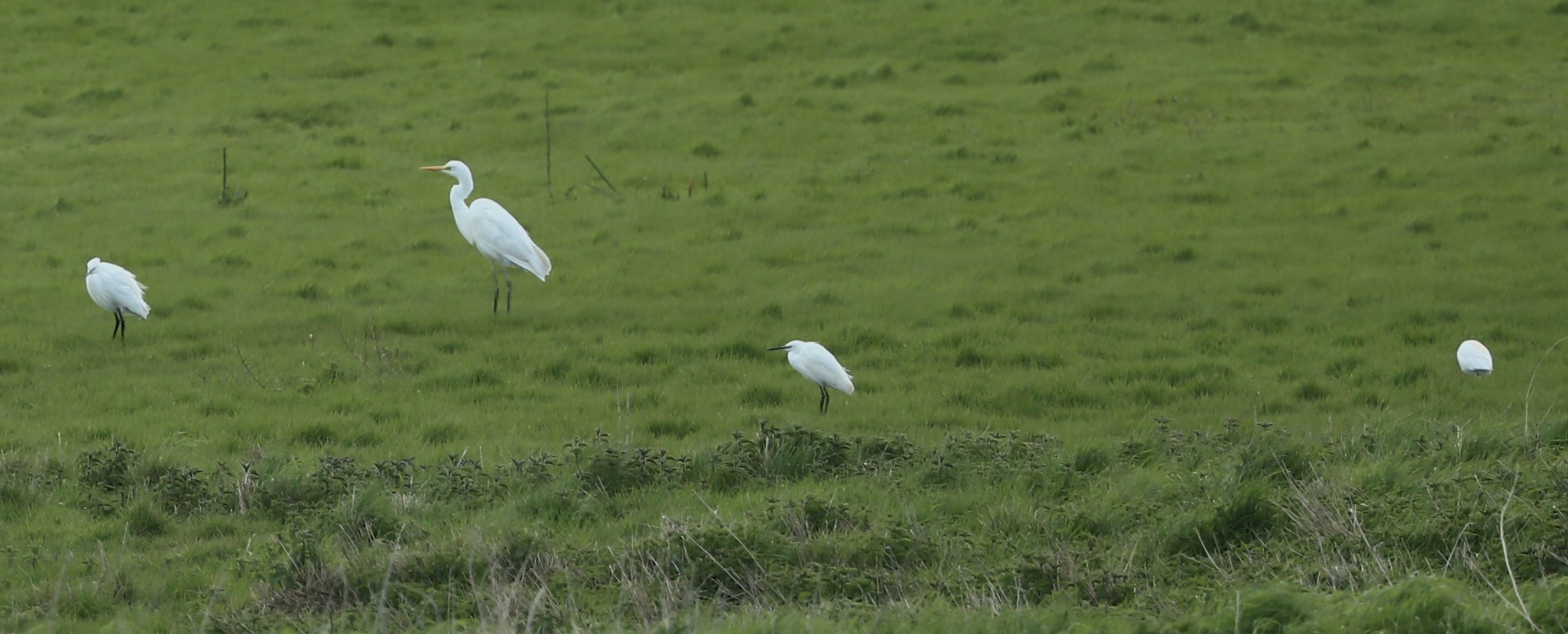
A single Cattle Egret seen with 2 Great White Egrets and 2 Little Egrets in the Watton Brook valley north of the Sewage Treatment Works. The Cattle Egret was later seen on the flooded meadow east of the STW. This record of Cattle Egret is my first on my local Breckland patch and although an exciting record, my feelings have been for some time that this species would be seen on my patch sometime in the near future.

Cattle Egret at Bodney 21 April 2024

With all three Egret species seen together, comparisons were easy to see.  The more familiar Great White and Little Egrets need no comparison notes, however, the Cattle Egret, being less familiar, showed obvious differences from the other two species.  The Cattle Egret was the smallest of all three species, it was also a stockier looking bird with a short, thick neck, a strong short bill, and a definite jowl.  A faint yellow-orange wash on the crown indicated this was a male bird.

The Cattle Egret was first seen in the company of two Great White Egrets and two Little Egrets on flooded meadow habitat.  The Cattle Egret fed by probing with occasional short chases for prey.  I noticed that the Cattle Egret often wandered into thick grass habitat in its search for food.


Wednesday, 12 June 2024

April 2024

1 April
A murky, grey start to the day with fair distant visibility.  Light was variable due to low cloud. The afternoon was brighter and quite warm.
An early morning visit to the boundary of the army training area at Bodney produced 2 singing Chiffchaff, one Blackcap, Song Thrush and Mistle Thrush.  A displaying male Curlew was a wonderful reminder of how important Breckland is to this bird, a species whose song is more reminiscent of lonely upland moorland habitat.
A flooded meadow held Mute Swans, Gadwall, Mallard, and a pair of Shelduck, and as expected, several Snipe were flushed from the wet ditch and nearby wet meadow.  
Two Cranes flew low and N/E and were watched until lost to view.  

3 April
I was just outside the small village of Garvestone when my attention was drawn to the distant call of Ravens, a short search of the area eventually revealed a pair of Ravens noisily calling and often alighting on one of the many pylons
Raven.  Increasing in Norfolk
6 April
The morning began with a single Siskin sitting in the top of our Ash tree, this bird rapidly departed upon the arrival of a female Sparrowhawk.
At Bodney, a very elegant Great White Egret was seen on a flooded meadow.  A very distinctive species, even at range.
A mid-morning visit to Hockham saw a pair of  Marsh Harriers displaying overhead. Also here was at least 3 singing Blackcaps and a pair of Chiffchaff engaged in courtship behaviour.

7 April
I decided to visit the path from Thompson Church to Griston road because the large meadow looks prime habitat for both passage Wheatear and Ring Ouzel, although none were seen it was good to see another target species at this locality, a pair of Stonechats.  The male bird was the most frequently seen bird as he hung onto the tops of tall weeds and bushes in the strong wind.  The ♀ Stonechat was seen later on one occasion on a bush top, I suspect her absence earlier was probably due to her being at her nest. 
A singing Willow Warbler was briefly heard rather distantly in suitable breeding habitat alongside the Drove Road, the wind did not help in trying to relocate the song again.
Also seen on this visit was a single Redwing.  I noticed a small Thrush-sized bird fly up from the ground into a thick hedge, this briefest of glimpses revealed the orange-red axillaries.  The bird was later relocated in a bush giving its alarm call.

11 April
I had a slow walk through the mature Scots Pines which looked good for Redstart, especially given the habitat similarities with Wretham Heath.  The Scots Pine habitat held singing Marsh Tit, Coal Tit, and Treecreeper, whilst overhead a ♂ Woodlark was performing its song-flight.  A little later the Woodlark was joined by a second bird, a chase ensued through and above the trees, at one point at height, both Woodlarks appeared to make physical contact.
The first of two Willow Warblers was seen and heard in song in open woodland habitat with scattered Hawthorn and Blackthorn with lots of Bracken ground cover.
A scan of bare ground and heath west of the road looked good for migrants, so a scan of the ground produced a single Northern Wheatear.  The bird was still and I first noticed the ochre throat and breast of the bird, a distinctive feature despite the distance.

12 April
A visit to Wayland Fields ponds in Watton produced a single Green Sandpiper around the muddy fringes of a pond.  Also seen here was a pair of Egyptian Geese with 8 young birds.

14 April
With an extended late morning work break I decided to pay a visit to Seamere Marsh at Hingham. The highlight of this visit was the presence of a singing Lesser Whitethroat (my earliest ever date for this Sylvia Warbler.
Also seen was a male Reed Bunting in suitable breeding habitat whilst overhead a male Kestrel was hunting.  A female Sparrowhawk soared overhead and two Swallows arrived over the marsh.  Both Blackcap and Chiffchaff were singing.    

16 April
Following on from my earliest Lesser Whitethroat on the 14th a further 3 singing birds were located in the Great Cressingham area on the 16th.  Reports from other parts of the country indicates there was a big arrival of this species on these same dates.

20 April
A visit to Thompson Common produced a singing Garden Warbler (first of the year) and a singing Cetti's Warbler.

21 April
A visit to the Watton Brook Valley at Bodney was to be a memorable one with all three Egret species seen together.  Two Great White Egrets, two Little Egrets, and a single Cattle Egret were all standing more or less together on wet grassland.
Even without the use of binoculars I could see that one of the Egrets was noticeably smaller and proportionally more thickset than the other two Egret species, I immediately thought Cattle Egret, and indeed it was.  Although an exciting find on my patch I was not too surprised as I thought the day would come when the species would visit.  The smallest of all three Egret species, this Cattle Egret had a stocky build with a short, strong looking bill (quite unlike the dagger-like bill of Cattle Egret) and a noticeable jowl.  I noticed that the Cattle Egret would wander through grassland more so than the other two Egret species.
Two Little Egrets, Great White Egret and Cattle Egret at Bodney

Cattle Egret at Bodney 21 April

Cattle Egret at Bodney 21 April

24 April
A forest clearing near Hockham held 2 Tree Pipits with both birds singing and launching their display flights from isolated trees within the clearing.  Also present in the same clearing was evidence of successful breeding by Stonechats when a pair was seen with at least 4 young birds. 


27 April
Golden Pheasants appeared to have become extinct in the local area, long gone are the days when I could see 25+ in Wayland Wood.  Another exotic, very large Pheasant is the Reeve's Pheasant, a beautiful male was seen near Great Cressingham.  Reeve's Pheasant is much larger than the more familiar Pheasant, it is stocky in build with a thick neck.  I have read that this bird can be aggressive towards humans.
Reeve's Pheasant (male)

A check of a flooded meadow at Bodney produced a single Whimbrel, this bird was initially seen roosting by the water but later started feeding in a nearby field.  A Curlew was seen to chase the Whimbrel on a couple of occasions, it was then that the obvious size difference was easily seen.  The striped head pattern was seen well and the bird called once whilst being chased by a Curlew.


Friday, 28 April 2023

Is it safe to go to the beach now?

 As you all know, I am not a twitcher, I am a Birder, and a Birder who has a passion for dogs. Equally, I love to share my passion with others who wish to learn.  What I do dislike are certain people who think our countryside, including our beaches are there for them only and for nobody else to share and enjoy.

I feel that our countryside and beaches are for all to enjoy providing they follow the countryside code, respect wildlife, and leave the countryside in a clean and tidy state upon their leaving.

Responsible dog owner know to keep their beautiful dogs on leads in sensitive area for wildlife, and indeed, those responsible people will hopefully respect certain areas where no dogs are allowed, and indeed areas where people as well who should go in order to protect wildlife and their sensitive habitats.  There are some irresponsible dog owners who should not be allowed to enter sensitive areas, however, in these cases it is rarely the fault of the dog.

I pride myself on not being a twitcher and I am careful to whom I reveal my finds too because I have seen evidence, both having read about and witnessed, when twitchers have worried birds, including species whose very nature is to skulk and remain in cover, but are subjected to organised flushes to see the bird.  I have also witnessed criminal damage in the pursuit of birds.  It is poor behaviour and totally embarrassing to see twitchers as they chase their quarry.  During the pandemic we witnessed in the media idiot twitchers breaking lockdown rules, causing dangerous conditions on our roads due to irresponsible parking, and trampling sensitive habitats as they go.

I equally dislike those who are critical of others using our beaches for their social recreation, dog walking, and taking the family out for the day.  Most families are responsible people, however, there are other families who let the side down.  On the whole, it muse be said that humans have the biggest impact upon the safety and wellbeing of wildlife on our beaches and in the wider countryside.

  On Sunday 23 April, I was birding on my local Breckland patch.  At the end of a great mornings birding I was confronted with the ugly side of humanity when over a 1/2 mile stretch of roadside I collected 2 large (and eventually, very heavy bags) of litter thrown out of cars.  Clearly, the offenders here have an underdeveloped brain and are unable to put together a few letters forming a single syllable word, the word is BIN, well use it then.  I however feel sorry for these offenders as they clearly have an inability to distinguish right from wrong.
I also dislike certain elements of society who feel noisy children should not visit the beach etc, it must be remembered that those who are critical were once children themselves, more importantly, a noisy child who visits the beach may be that person whose curiosity about something they have seen or heard may be the spark needed to get them interested in wildlife and our countryside, after all, the children of today will be the future custodians of our countryside.  So don't be critical of our future environmentalists and naturalists.  

To end, I will once again repeat my dislike of twitcher types who feel dogs, and children should not be on our beaches and countryside.  These selfish people are equally not welcome in the countryside if they are not willing to share it.


Saturday, 22 April 2023

A passage of Seven Whistlers and first Nettlecreeper of the year - 20th April 2023

 On the morning of 20th April I decided upon a walk along a 3 mile route on my patch around the Cressinghams in Norfolk.  The day dawned bright with cloudless skies and a moderate NE wind. The habitat I was passing through is well suited to Sylvia Warblers, so therefore, target species was to be either Lesser or Common Whitethroats.

As I was walking west towards Great Cressingham I became aware of distant birds high approaching from the west, this was a small flock of 9 Whimbrel, quite high and in a loose V formation.  I continued to watch the birds as they made their way east in the beautiful clear blue sky.  
Whimbrels are a scarce bird of passage on my patch and usually occur as single birds, therefore 9 together is a great patch record.
The Whimbrel is colloquially known as 'seven-whistler', this being due to the series of seven or so piping notes given by the bird, very distinctive and easily identifies this migrant.

Along my route several Blackcaps were in song as expected and on overhead wires in the village was a single Swallow whilst high up a number of House Martins wheeled about in the sky.

A low soaring Red Kite drew the attention of mobbing Lapwings and once it had alighted in a tree it then became the target of angry Jays.  Nearby a Little Owl was calling.  
It was while I was watching the Red Kite I heard a Raven calling.  Once a very rare vagrant in Norfolk, this very impressive crow species is being seen and heard with some frequency on the patch.  Usually I see single or pairs of Ravens, however, my best single count on my patch was 3 birds together.

As I approached the end of my walk, one of my target species for the day, a Whitethroat, was briefly singing from within the cover of a hedge, a slightly later arrival date for this Sylvia, but always a welcome returning migrant which always raises a smile and a "Welcome back beautiful" under my breath.  
Whitethroat or "Nettlecreeper"

Whitethroats is a species which has endured serious struggles following a very concerning population crash on their wintering grounds in the Sahel region of Africa when a drought in the winter of 1968/69 saw a crash in numbers of Whitethroats, a reduction in numbers so severe that it was reported that 90% of birds failed to appear in Britain the following summer to breed.  Numbers of Whitethroats have steadily increased since this dreadful time, however, not yet to pre-crash levels.  It is because of this desperately sad event that Whitethroats hold a special place in my heart and always bring a welcoming smile to my face.
The wintering grounds of the Whitethroat is in the Sahel, this is along the southern most boundary of the Sahara Desert and stretches from the Atlantic in the west to the Red Sea in the east, and is about 200 miles north to south.  The climate of the Sahel is tropical to subtropical.

I love to use colloquial names for birds, one of those for the Whitethroat is the "Nettlecreeper", an apt description for a species which skulks and nests within ground covering herbage.         

Sunday, 16 April 2023

Arrivals of the first summer migrants

From mid-March each year the first summer migrants begin to appear  on the patch with arrivals soon settling down to sing and reaffirm their territories, or passing through on their way to their breeding grounds elsewhere in the country, or indeed beyond.

One of our earliest returning migrants is the Chiffchaff, my first this year was on 11th March at a local sewage treatment works, a type of facility which provides a microclimate and good feeding for newly arrived birds.  Following this first bird, Chiffchaff numbers began to increase from mid March with some sites holding several singing birds.

Male Blackcap

The last week of March usually sees the first Blackcaps arriving on territory, my first of the year was at Bodney on 27th March.  The beautiful song of the Blackcap always brightens woodland which may still be in the final grips of winter.
Blackcaps are found in a variety of habitats with most seen in open woodland, they will readily use overgrown hedgerows, scrub, and mature gardens.
Female Blackcaps differ from males in appearance by their brown caps, although be aware, all juvenile Blackcaps have brown caps until males moult into the familiar black caps.

On 4th April, I visited Croxton Heath hoping to find Adders, however, none were found, but, I did locate at least 4 Willow Warblers, a species which arrives the last day of March, but most in the first days of April. 

My first Swallow of the year was a male bird seen at Saham, this was likely a passage bird as I watched it flying purposefully west along a river valley until lost to view.

Wheatear at Bodney 14 April (One of 3 birds together)
Another early migrant is the Wheatear, this species usually arrives in latter half of March, however, this year my first were seen at Bodney on 14th April, on this occasion 3 birds were seen together (2 males and female).  Wheatears are birds of open country, typically on rolling grassland, farmland, and upland moors.  Nest sites include disused Rabbit burrows and cavities in stone walls. 
Wheatear is an old English word, it's modern translation means 'White Arse' owing to its large and highly distinctive white rump which is particularly visible on the flying bird.


At the time of writing (16th April) look out for and listen for the first Cuckoos and in the last week of April, look to the sky for the first Swifts.

Monday, 13 March 2023

11th and 12th March 2023

An interesting weekend with my first summer migrant on the patch and evidence of courtship and display seen including a recently returning Curlew, a scarce breeding species in Breckland.  

11th March

My first destination was on private land at Little Cressingham within the training area, here, woodland held singing Mistle Thrushes and drumming Great Spotted Woodpeckers.  As the sun rose and it warmed up a little, a female Goshawk broke cover and began soaring over woodland in a prelude to display, a male Goshawk was also seen.

On farmland and heath a male Curlew was displaying song-flight, a wonderful display and song more often heard on upland moorland.

A walk along a wide grass margin produced a pair of Woodlarks on short grass whilst in a pine woodland several hundred winter Thrushes had gathered with the majority species being Redwings, which were also heard singing.
A lovely very wide roadside verge held a male Stonechat in what is possibly a breeding site for the species. The verge is a mini wildlife reserve comprising rough grassland, hedgerow, Hawthorn, and Gorse scrub, an ideal breeding habitat for Stonechats. 

Nearing the end of this particular walk I was greeted by the delightful song of a male Woodlark high overhead.

Chiffchaff at Threxton 11 March
My next stop was in the beautiful parish of Threxton, an area dominated by very undulating farmland, meadows and river.  A very notable observation was seeing many thousands of midges swarming around the top of the church tower which in turn attracted feeding Pied Wagtails to enjoy the veritable feast.  In the churchyard a recently arrived Chiffchaff was seen skulking in cover where it occasionally sang and called, the bird also broke cover on one occasion to chase a Blue Tit.
A pair of Goldcrests seen (male singing), a pair of Song Thrushes, and a pair of Mistle Thrushes on a meadow where earthworms were pulled from the ground..  10+ Meadow Pipits and a few Pied Wagtails fed on the meadow. 

12th March

Goshawk shadowed by Crows 12 March
A good morning where common species well represented, most notably, 250+ Fieldfare and many Redwings seen.  Nearby, 200+ Starlings wandered the valley. On grassland heath a displaying Curlew seen with Lapwings also on same area of heath.
A pair of Stonechats were seen on marshy floodplain, also 14+ Meadow Pipits seen and a few Pied Wagtails too.
Four raptor species seen began with 3 soaring Buzzard over woodland where later a Sparrowhawk emerged.  One Kestrel also seen.  
Just as I was packing up to leave I saw an approaching Goshawk, the bird passed directly overhead with mobbing Crows shadowing the raptor.